


Automated Contact Tracing in Hospitals is Redefining Infection Prevention and Control
Over the past two decades, hospital responses to infectious disease threats have followed a familiar pattern. An infection is identified. Teams mobilise. Staff retrace movements. Large contact lists are assembled from memory, notes and disparate systems. Hours pass. Sometimes days.
By the time containment measures are fully implemented, further transmission may already have occurred.
This is not a failure of dedication. It is a limitation of the process.
Automated contact tracing directly addresses that limitation.
In complex clinical environments where hundreds of interactions occur every hour, manual reconstruction of exposure pathways is no longer sufficient. Objective, real-time data is now both possible and necessary.
What Automated Contact Tracing Actually Means in Practice
Automated contact tracing in a hospital setting is not a theoretical concept. It is a continuous, structured method of recording clinically relevant proximity events between individuals.
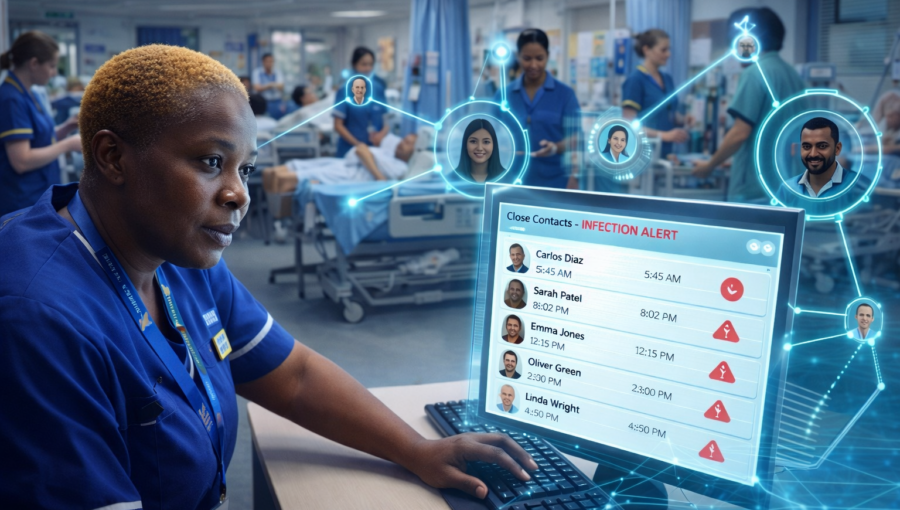
Staff and patients wear small, unobtrusive devices. Fixed location hubs provide high indoor positional accuracy. A secure clinical interface enables infection prevention teams to review encounters immediately upon case confirmation.
The moment a new infection is entered into the system, exposure data becomes available:
- Who met defined close-contact criteria
- How long each interaction lasted
- The distance involved
- Where it occurred
- When it occurred
- What locations or assets may now be of interest to help inform interventions
This replaces retrospective interviews and guesswork with evidence.
Why Traditional Contact Tracing Breaks Down in Hospitals
Hospitals are not static environments.
Patients transfer between wards. Clinicians rotate across departments. Agency staff fill gaps. Equipment moves constantly. Visitors arrive and leave.
Under these conditions, recall-based tracing is vulnerable to three weaknesses:
- Inaccurate human recall
- Long lists of potential contacts from EPRs and staff rosters
- Manual workload sorting through the data
When exposure decisions rely on reconstruction, small inaccuracies compound quickly. The manual process can often be longer than the incubation period of the pathogen. And during outbreaks, the scale of tracing required can overwhelm even experienced teams.
Automated contact tracing removes these structural weaknesses.
Precision Matters in Infection Control
Infection prevention is not simply about identifying contact. It is about identifying meaningful contact.
Exposure definitions vary by pathogen. Some infections require prolonged proximity. Others require only brief contact at close range. Some risks are location-based. Others are person-to-person.
A robust automated system allows infection prevention teams to define thresholds appropriate to each scenario. It provides:
- Configurable time and distance rules
- Accurate indoor location data
- Clear time-stamped audit trails
- Immediate reporting capability
This level of precision enables proportionate responses. Not every contact requires isolation. Not every ward requires closure. Decisions can become data-informed rather than precaution-driven.
The Clinical and Operational Impact
The value of automated contact tracing extends beyond outbreak response.
From a clinical perspective, earlier interruption of transmission reduces secondary infections. Even small percentage reductions have significant consequences for patient outcomes.
From an operational perspective, the benefits include:
- Reduced staff sickness absence
- Lower treatment costs
- Fewer extended stays
- Increased elective capacity
- Less disruption during seasonal pressures
Importantly, automated systems also recover clinical time. Infection prevention professionals can focus on strategy, education and mitigation rather than administrative reconstruction.
Privacy and Professional Trust
Any digital system introduced into a healthcare environment must respect privacy and professional autonomy.
Effective automated contact tracing is designed with clear safeguards:
- Data minimisation
- Secure storage
- Controlled access
- Clear governance frameworks
The purpose is protection.
When healthcare workers understand that the system exists to safeguard them and their patients, adoption becomes far smoother.
Preparing for the Next Communicable Threat
We should not assume that large-scale outbreaks are historical events. Seasonal respiratory infections, emerging pathogens and antimicrobial resistance continue to challenge health systems.
Hospitals cannot eliminate the risk of introduction. What they can do is reduce onward transmission.
Automated contact tracing strengthens preparedness by ensuring that exposure pathways are visible in real time. It allows hospitals to respond decisively before small clusters become major disruptions.
The data collection can also be used to provide insights on the effectiveness of preventative measures, creating evidence driven learning loops.
From Reactive Investigation to Preventive Control
Most communicable diseases spread from one person to another. If transmission chains are interrupted early enough, wider spread can be prevented.
Automated contact tracing provides the infrastructure to do exactly that.
It replaces uncertainty with evidence.
It replaces delay with immediacy.
It replaces reconstruction with visibility.
For hospitals seeking to measurably and sustainably strengthen infection prevention, automated contact tracing is no longer an experimental approach. It is a logical evolution in how modern healthcare environments manage communicable disease risk. It is fully aligned with the shift from treatment to prevention, and the shift from analogue to digital.
If you are evaluating infection-prevention investments, we would be pleased to share how trials show automated contact tracing could support both patient safety and operational performance at your hospital.
About The Author
